

Blog, Cash Counting Machines
How Modern Currency Counters Detect Counterfeit Notes
In the modern business world, where cash transactions remain a significant part of global trade, the risk of counterfeit currency is a constant concern. Traditionally, identifying fake notes relied on manual inspections—bank clerks would scrutinize watermarks, feel for the texture of high-quality intaglio printing, or even “taste” notes to detect unusual materials. Today, however, currency counting machines have evolved from simple tallying tools into sophisticated “intelligent guardians” that can verify and authenticate every note in a stack instantly.
These machines use a multi-layered approach to security, employing several advanced technologies to distinguish genuine currency from sophisticated fakes.
Core Detection Technologies
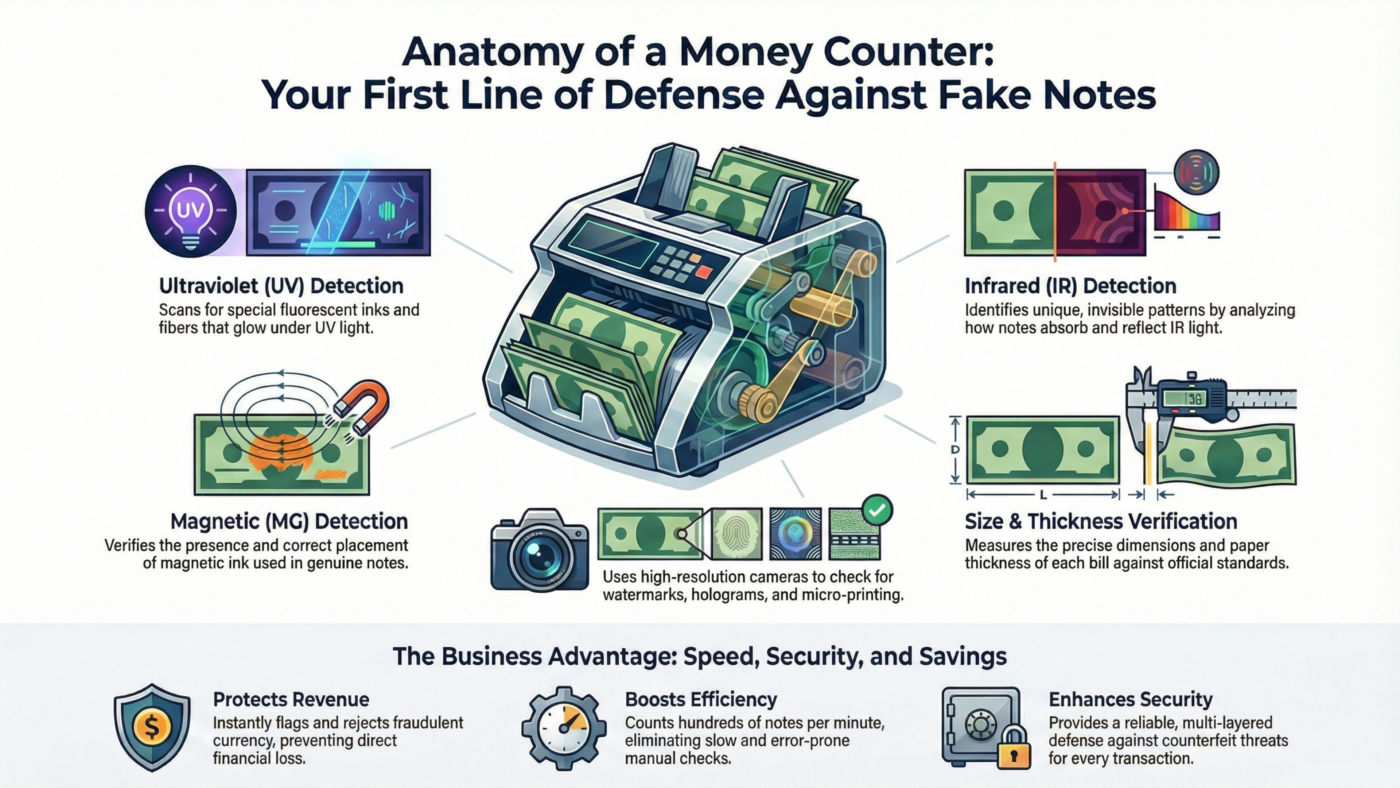
Modern money counters act as high-speed scanners, pulling notes through a series of rollers and sensors to examine multiple security features simultaneously.
Ultraviolet (UV) Detection
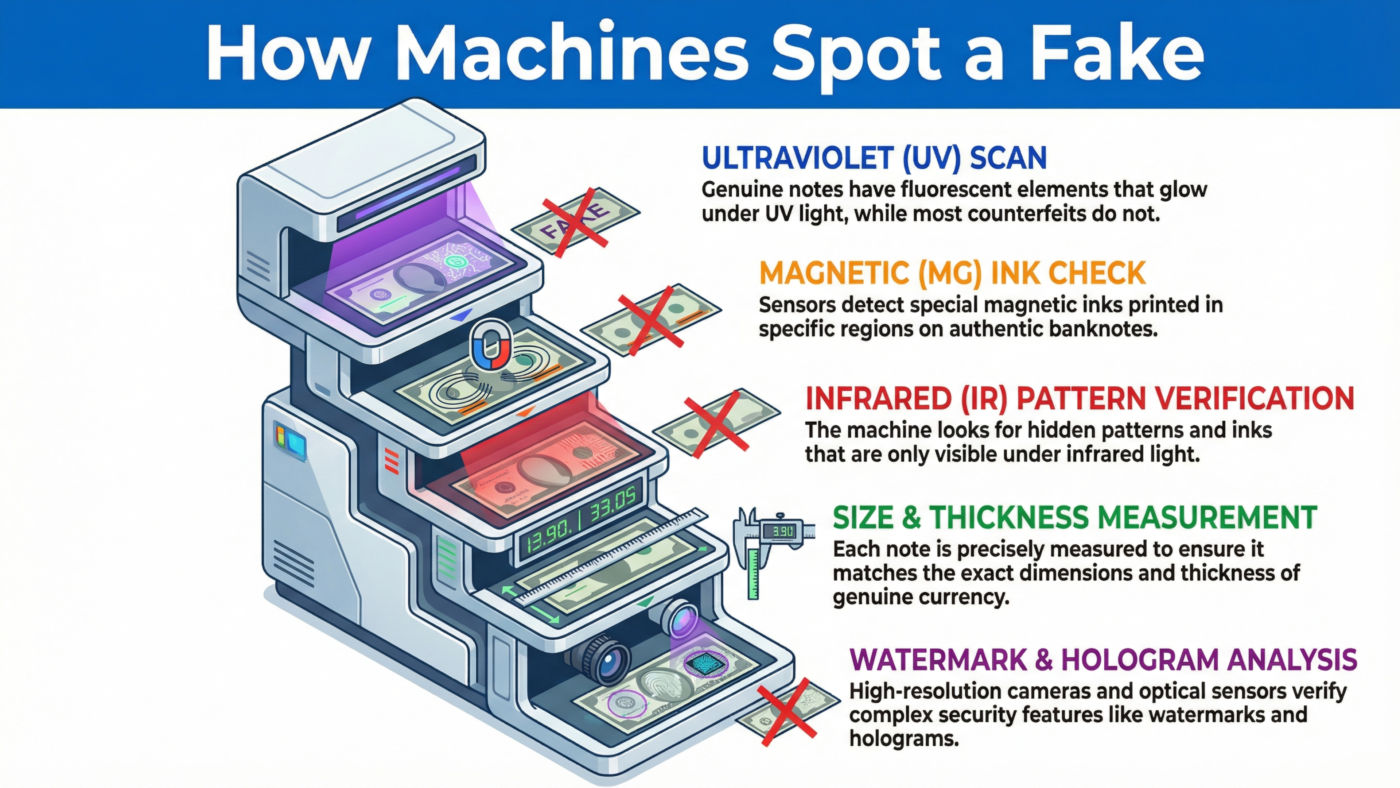
This is the most common and affordable method used in currency counters. Genuine banknotes are often printed with UV-sensitive inks and fluorescent elements that are invisible under normal light but glow under ultraviolet sensors. If a note lacks these specific markings or reflects the light incorrectly, the machine flags it as suspicious.
Magnetic (MG) Detection
Many world currencies utilize magnetic inks in specific regions of the note. Counting machines are equipped with magnetic sensors that detect these unique “magnetic signatures” and their correct placement. Because these magnetic properties are difficult for counterfeiters to replicate accurately, MG detection is considered a highly reliable security measure.
Infrared (IR) Detection
Banknotes often feature hidden patterns that reflect or absorb infrared light in specific, recognizable ways. IR sensors in the machine compare the infrared data of each note against stored authentic patterns. Any deviation, even a slight mismatch in the invisible ink pattern, will cause the machine to stop and signal a counterfeit.
Size and Thickness Detection
Authentic banknotes are manufactured with precise dimensions and on paper with a specific thickness. As notes pass through the machine, sensors measure these physical attributes in real-time. If a note is slightly shorter, thicker, or thinner than the standard, it is immediately rejected or marked as invalid.
Advanced Optical and Pattern Analysis
While basic sensors handle UV and magnetic properties, advanced machines utilize high-resolution imaging to detect more intricate security features.
Watermark and Hologram Verification
Many banknotes contain complex holograms and watermarks that are extremely difficult to reproduce. High-quality counters use optical sensors and image recognition software to verify these features, saving businesses from having to perform time-consuming manual backlit checks.
Color Spectrum and Pattern Analysis
Every denomination is printed with unique patterns and color inks. Advanced machines use spectrum sensors to perform color analysis, which can quickly flag irregularities, particularly in lower-quality counterfeit notes.
Micro-printing and OCR
Genuine currency often contains microscopic text and serial numbers that are challenging for counterfeiters to replicate with clarity. Machines equipped with high-resolution cameras can scan these details, and some can even utilize Optical Character Recognition (OCR) to track and record serial numbers at speeds up to 1,000 notes per minute for audit purposes.
Why Automated Detection is Essential for Business
The threat of counterfeit currency is not just historical, such as the WWII “Operation Bernhard” which aimed to destabilize the British economy, but a modern reality. While counterfeit rates in some regions like the Eurozone are relatively low (about 18 per million notes), other areas have seen much higher rates of fake currency in circulation.
For businesses, especially small and medium-sized ones with thin margins, accepting even a few fake notes can result in a direct financial loss, legal complications, and a damaged reputation. Utilizing a machine with integrated UV, MG, and IR detection allows a business to:
- Protect revenue by catching fakes before they enter the system.
- Improve speed and accuracy by counting hundreds of notes per minute while eliminating human error.
- Ensure compliance with banking guidelines regarding the sorting of soiled or unfit notes