

Blog
UV vs MG vs IR Fake Note Detection: Which Sensors Actually Work?
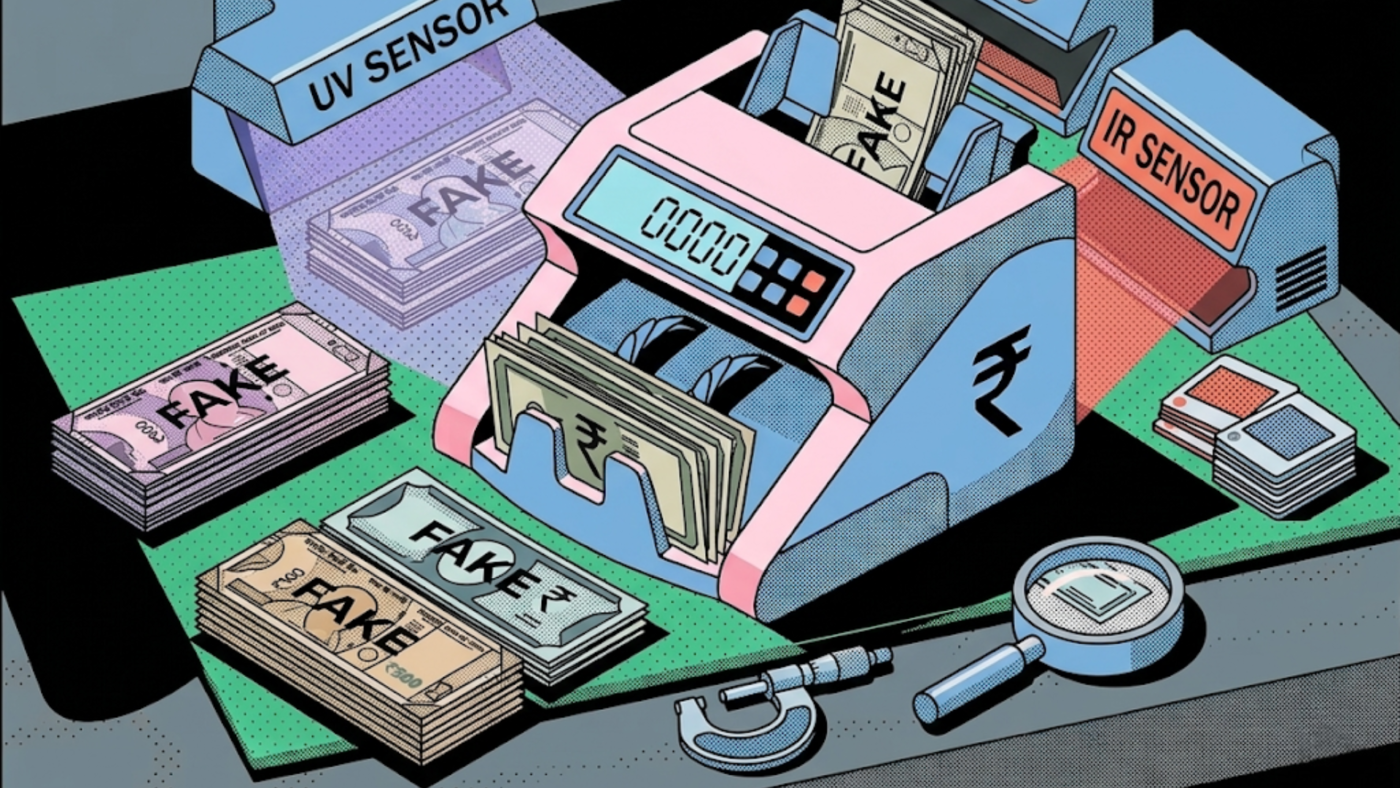
Every note counting machine sold in India claims to detect fake notes. Most of them do — to varying degrees. The difference between catching 80% of counterfeits and catching 99% comes down to which sensors are inside the machine and how well they’re calibrated. See which models include each sensor at which price point →
Why Indian Businesses Need Counterfeit Detection
The RBI’s annual report consistently highlights counterfeit ₹500 notes as the most seized denomination in India. The challenge is that well-made fakes can feel similar to genuine notes — particularly to someone counting cash quickly at the end of a busy shift. Manual visual inspection catches obvious fakes. The fakes that circulate at scale in the market are not obvious. That’s the problem a proper sensor suite solves.
UV (Ultraviolet) Detection
Genuine Indian banknotes are printed with UV-fluorescent ink in specific locations on each denomination. Under ultraviolet light, these areas glow in distinctive patterns — patterns that counterfeiters printing on ordinary paper cannot replicate without specialist materials.
How it works
A UV lamp inside the machine shines ultraviolet light onto each note as it passes through. A photodetector measures the fluorescence. If a note doesn’t fluoresce in the right places with the right intensity, the machine flags it.
What UV catches and misses
UV catches notes printed on plain photocopier or standard inkjet/laser paper. However, a counterfeit manufacturer who has sourced UV-reactive spray can produce a note that passes a UV-only check. UV-only detection is sufficient for very low-risk environments; for any commercial business handling ₹50,000 or more daily, UV alone is not adequate.
MG (Magnetic Ink) Detection
The RBI uses magnetic ink — ink mixed with magnetic particles — to print specific security features on genuine banknotes. An MG sensor measures the magnetic signature of each note and compares it against the expected pattern for genuine Indian currency.
What MG catches and misses
MG catches notes printed with standard non-magnetic ink (the vast majority of counterfeits) and UV-spray-treated fakes that pass the UV check. Sophisticated manufacturing operations that source genuine magnetic ink are rare but do exist at higher denomination counterfeit operations.
Verdict on UV + MG
This combination is the practical standard for Indian commercial businesses. UV + MG together catches the overwhelming majority of counterfeits circulating in Indian markets. For a retail shop, restaurant, petrol pump, or small business, UV + MG is the right minimum.
IR (Infrared) Detection
This is the most technically sophisticated of the three sensor types. Genuine banknotes have a unique infrared transmission profile — essentially, a fingerprint of how the note absorbs and transmits infrared light based on its ink density, paper composition, and design elements.
What IR catches
High-quality counterfeits with magnetic ink and UV treatment that pass both UV and MG checks, notes with correct physical dimensions and texture but wrong printing characteristics, and bleached genuine notes reprinted with fake higher denominations.
Why financial institutions require IR
RBI inspection protocols for currency chests include IR-level verification. Machines with UV + MG + IR provide institutional-grade confidence that aligns with RBI cash management standards.
Which Sensor Combination Do You Need?
| Business Type | Minimum Sensors | Recommended Models |
|---|---|---|
| Small shop, home, petrol pump, society | UV + MG | Steadfast Libor 77 (₹8,100), Godrej Ace Pro Green (₹5,500) |
| Retail chain, restaurant, hotel | UV + MG + IR | Steadfast Banko 7V (₹9,500), Banko-22 (₹11,000) |
| Bank branch, NBFC, gold loan company | UV + MG + IR (required) | Steadfast Banko 22 Pro+ (₹12,000), Banko 20 (₹15,500) |
| Currency exchange, RBI chest, CIT company | UV + MG + IR + Image | Glory GFS-220 (₹1.45L), Glory USF-200 (₹3.65L) |
Frequently Asked Questions
Can a UV-only machine catch a fake ₹500 note?
It can catch basic fakes. A UV-only machine would miss a counterfeit that has been treated with UV-reactive spray. Since ₹500 is the denomination most targeted by professional counterfeiters, UV + MG at minimum is strongly recommended for any business regularly handling ₹500 notes.
Do sensors need recalibration over time?
The sensor technology is solid-state and does not require periodic recalibration. What does matter is keeping the sensor lenses clean — dust and ink residue on the sensor window reduces detection accuracy. A monthly wipe with a lint-free cloth is sufficient for most commercial use.
Are all Transtronix India machines UV + MG?
Yes — UV + MG is the minimum on every machine we stock. UV + MG + IR is available on all commercial Steadfast Banko models from the 7V upward. Contact us to confirm the sensor suite on any specific model.
Related Articles: In This Series
Complete Guide to Note Counting Machines India (2026) — The full hub article covering all types, features, and use cases.
Note Counting Machine Price India 2026 — Which models include UV+MG+IR at which price points.